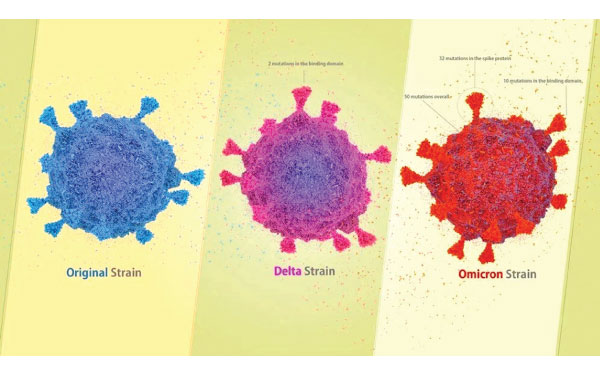
UAE: Get ready to learn more Greek letters. Scientists warn that omicron’s whirlwind advance practically ensures it won’t be the last version of the coronavirus to worry the world.
Every infection provides a chance for the virus to mutate, and omicron has an edge over its predecessors: It spreads way faster despite emerging on a planet with a stronger patchwork of immunity from vaccines and prior illness.
That means more people in whom the virus can further evolve. Experts don’t know what the next variants will look like or how they might shape the pandemic, but they say there’s no guarantee the sequels of omicron will cause milder illness or that existing vaccines will work against them.
It’s why they urge wider vaccination now, while today’s shots still work.
“The faster omicron spreads, the more opportunities there are for mutation, potentially leading to more variants,” Leonardo Martinez, an infectious disease epidemiologist at Boston University, said.
Since it emerged in mid-November, omicron has raced across the globe like fire through dry grass. Research shows the variant is at least twice as contagious as delta and at least four times as contagious as the original version of the virus.
Omicron is more likely than Delta to reinfect individuals who previously had COVID-19 and to cause “breakthrough infections” in vaccinated people while also attacking the unvaccinated. The World Health Organization reported a record 15 million new COVID-19 cases for the week of January 3-9, a 55 percent increase from the previous week.
A variant could also achieve its main goal — replicating — if infected people developed mild symptoms initially, spread the virus by interacting with others, then got very sick later, Ray explained by way of example.
Experts say the virus won’t become endemic like the flu as long as global vaccination rates are so low. WHO Director-General Tedros Adhanom Ghebreyesus said that protecting people from future variants — including those that may be fully resistant to today’s shots — depends on ending global vaccine inequity. Tedros said he’d like to see 70 percent of people in every country vaccinated by mid-year.
– ARAB NEWS