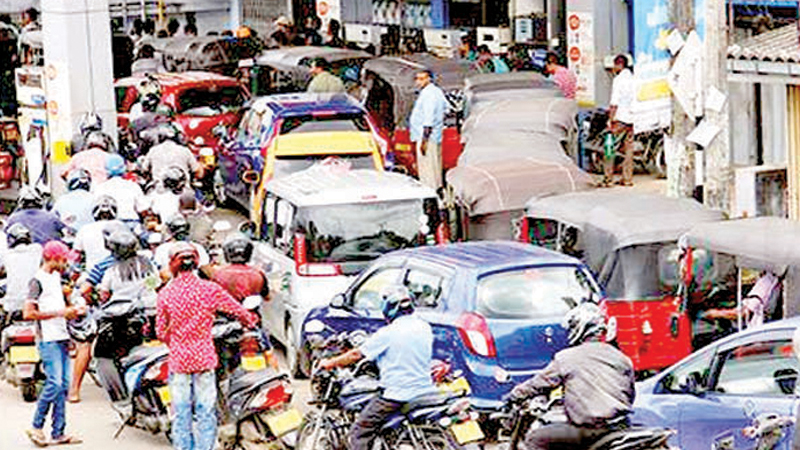
The real price of petrol and diesel is significantly higher than currently sold. As the price of fuel is significantly subsidised this promotes consumption. This is in direct contrast to the government’s other policies that are aimed at reducing imports.
Providing fuel subsidies also disincentivises fuel efficiency. World Bank estimates show the top 30% of society consumed and overwhelming 70 % of fuel sold in the country. There is little sense in channelling public funds to subsidise the relatively well-off segments of society. Hence a targeted subsidy transferred directly to vulnerable households requires far fewer funds and will address the needs of poorer segments of society.
The losses incurred by the energy utilities have been financed by the State banks and have grown so large that they now threaten the stability of the banks. The total liabilities owed by the state-owned monopoly, the CPC (Ceylon Petroleum Corporation) to the banking sector is a staggering Rs. 529.2 billion (USD 2.5 Bn). Ensuring that energy prices are no longer subsidised will lessen further debt accumulation within the State banks.
Therefore a sharp increase in prices is now unavoidable but necessitated due to the imbalances that have built up within the economy. Unless the root causes of the problem are addressed and the interest rates, foreign exchange rates and other key prices within the economy are allowed to be determined by market forces these imbalances will continue to be a recurring problem.
Although there have been some increases in fuel prices recently, they are inadequate. Sri Lanka presently sells diesel at a significant loss. At present market prices, diesel is still sold at a loss of LKR 46.80, while petrol is sold at a loss of LKR 18.37. Sri Lanka continues to provide fuel at cheaper prices in comparison to our neighbours such as India and Bangladesh. The selling price of petrol in India is about LKR 259.44, while diesel is about LKR 235.8. The selling price of petrol in Bangladesh is about LKR 202 while diesel sells at about LKR 188.23. Fuel, therefore, continues to be underpriced, highlighting a serious structural flaw in Sri Lanka’s fuel pricing mechanism.
Another key reform should include the elimination of all barriers to entry to Sri Lanka’s energy sector. Enhancing competition by allowing more players to operate in the market is the only means of achieving both stable supply and stable prices in the long term.
Instead of continuing with the general subsidy, the government should look at introducing a market-driven pricing formula to determine prices at the pump. Immediate and urgent measures to bring about macroeconomic stabilisation needs to go hand in hand to come out of this difficult situation.
Key Points
* Advocata Institute calls for the implementation of an effective fuel pricing formula.
* Pricing energy correctly reduces the build-up of imbalances.
* Reducing barriers to entry and promoting open markets in energy is the only viable option to reducing fuel prices.
* The current crisis requires far-reaching measures and allowing the price system to function is a crucial step in dealing with the problems.
* Using direct cash transfers to address the issue of equity is more efficient than subsidising all users of a product; the Samurdhi scheme will have to be re-examined for these purposes.
Advocata can be contacted on yasodhara@advocata.org