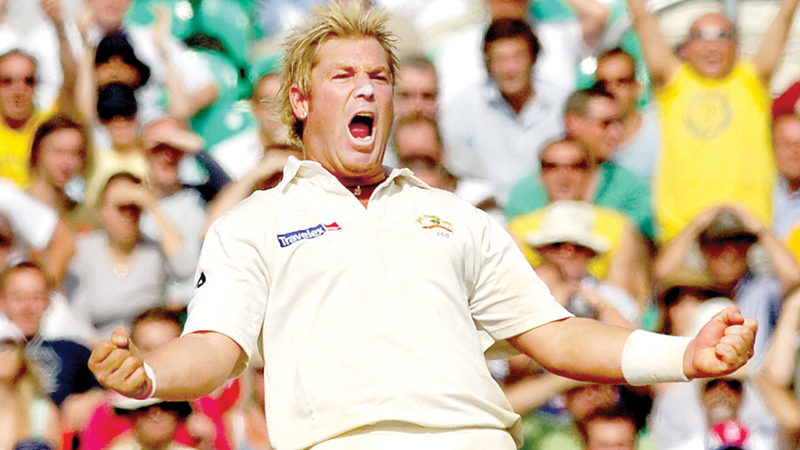
Shane Warne, who has died aged 52 in Thailand of a suspected heart attack, was almost certainly the greatest spin bowler cricket has ever produced. More than that, he was one of the most outsize personalities of any sport at any time. Everything he did in his game and his life was on a grand scale: he lived fast and, it transpires, died young.
Warne single-handedly revived the discipline of leg-spin, which by the time he burst into Test Cricket in the 1990s was almost a lost art. He arrived into an Australia team that had already embarked on a run of eight Ashes series wins and made it overwhelmingly stronger – he was still in the business of terrorising Englishmen when he retired from Test Cricket 14 years later.
Spin bowlers in his era, certainly English ones, often found themselves apologetic figures brought on to give a little breather to the fast men, who had begun to dominate the sport, certainly outside Asia. Warne was the reverse: he was not just a master of his craft; he commanded the arena.
He made that clear from the first ball he bowled in an Ashes Test, to Mike Gatting at Old Trafford: “Two-thirds of the way down the pitch the ball dipped into the leg-side, opening Gatting up like a can of beans, before ripping diagonally across his body to clip the outside of off-stump,” wrote Mike Selvey in the Guardian. “Gatting stood his ground, not in dissent or disappointment but in total, utter disbelief.”
At the time some called it the Ball from Hell. As time went by it was sanctified as the Ball of the Century.
Warne was born and brought up in the Melbourne suburbs, the son of Bridgette, who had come to Australia aged three, and Keith. He was not remotely academic but at 15 he won a sports scholarship to the Mentone Grammar School which, he concluded, licensed him not to be academic at all. Cricket was not his obvious sport; at first, Australian Rules, tennis and swimming might have been ahead of it.
Yet his special brilliance at cricket was connected with the attributes needed for those three; he had extraordinary upper-body strength: shoulders, arms and wrists. Warne himself thought this might be connected with him breaking both legs when he was eight and having to wheel himself round in a cart. Plus he had a natural gift at spinning a cricket ball. At first he was seen as a batsman who bowled a bit. But as he moved through the ranks at one of Melbourne’s top-grade clubs, St Kilda, bowling took over.
Warne was always an Australian archetype – the lovable larrikin who disobeys the rules but triumphs. He irritated teammates with his flashy cars (from teenage days) and dyed blond hair. He irritated by-the-book coaches, notably at the Australian Cricket Academy, with his disdain for their ideas of fitness and discipline.
Best leg-spinner in the world
But he proved himself cricket-fit and was plunged into the Australia team against India in January 1992, although he did nothing much in that match and was dropped. The following winter he bowled Australia to a stunning victory over West Indies when he turned 143 for one to 219 all out. Then in New Zealand he took 17 wickets in three Tests, and Martin Crowe, the opposing captain, called him the best leg-spinner in the world.
When he came to England with Australia that spring, Warne worked away early in the tour at Worcester while Graeme Hick hit him everywhere except into the river and the Cathedral. Overhyped, it was said. With hindsight, that day must be seen as part of the master plan. There were no unbelievers after the Gatting ball.
Unlike the previous leg-spin standard-bearer, the Pakistani player Abdul Qadir, Warne did not use the googly as his major weapon. He quickly became a master of the flipper, which also turned the presumed wrong way, but with the help of backspin. He mastered many other variants, some of which may have existed only in opponents’ heads. “If the batsman thinks it’s spinning,” as one old-timer put it, “it is spinning.”
He was also a master of performance art, facial expressions, unexpected stops and starts, never letting the batsman settle. And, when all else failed, good old Australian sledging.
The wickets and landmarks kept coming, but so did the scrapes. It was belatedly revealed that he had been involved in the first manifestation of cricket’s problems with match-fixing when he had taken money for giving information about pitches and weather to a Sri Lankan bookmaker. It was at the bottom end of the scale of potential illegality but caused great reputational damage at the time.
More scrapes followed, above all the use of a banned diuretic, for which he was banished for a year and which he rather ungallantly appeared to blame on his mother. Thus Warne never did become Australia captain, at which he might well have excelled. But his Test career ended in a blaze of glory when Australia avenged England’s nation-stopping theatrical Ashes victory of 2005 by crushing England 5-0. In his 144th and penultimate Test, he took his 700th Test wicket.
Warne also broke the mould by proving spin bowlers could succeed in one-day cricket. He captained the Rajasthan Royals to the first Indian Premier League (IPL) title in 2008 and proved an effective and popular captain and coach in England with Hampshire. He enjoyed his celebrity and all that it brought him. There was a brief, highly publicised relationship with Liz Hurley.
He remained a handsome, charismatic, fun-loving figure who did not slow down. Behind it all, he was charming and at heart, a true son of the game. He was named one of the five “Cricketers of the 20th Century” by Wisden in 2000 and was both gracious and chuffed to bits. Everyone in cricket will be devastated that the carnival is over. He is survived by three children, Jackson, Summer and Brooke, from his 1995 marriage to Simone Callahan, which ended in divorce in 2005.
Yet statistics, however impressive, fail to do Warne justice. There was a flamboyance and excitement about his bowling, symbolised by the first ball he ever sent down against England, in 1993. He took 708 Test wickets in a 145-Test career, a record for any Australian and second globally to Sri Lanka’s Muttiah Muralitharan (800 wickets), who said the global cricket fraternity was in shock.
“One of a kind”
Australian Prime Minister Scott Morrison said Warne was “one of only a few that could approach the extraordinary achievements of the Great Don Bradman” in Australian cricket. But he was also a giant of the country’s life and story, a “one of a kind” who brought magic to Australian summers.
Opposition Leader Anthony Albanese said Warne was a “phenomenal sportsman” and a legend whose extraordinary innings had ended far too soon.
“When he had the ball in his hand, he was a magician,” he said. “He was a larrikin and an artist, and he changed the game he loved in the process. To watch him in action was just one of the purest joys sport had to offer.”
Warne’s family has been offered a state funeral by the Federal Government, which Morrison said would be arranged in consultation with Cricket Australia and the Victorian Government. The State’s Premier, Daniel Andrews, announced the MCG’s Great Southern Stand would be renamed the S.K. Warne Stand as “a permanent tribute to an amazing Victorian”.
Just hours before his death, Warne had paid tribute to fellow cricket great wicketkeeper Rod Marsh (74) , who died in Adelaide earlier on Friday. Warne had also posted in recent days about being on a fitness spree, or “operation shred” in his words.
The Indian cricket team observed a minute’s silence before the start of play on day two of the first Test against Sri Lanka to pay respect for both Warne and Marsh, while the women’s cricket teams of both Australian and England held a moment of silence before a match in New Zealand on Saturday.
In Melbourne, cricket fans came from across Victoria to visit the statue of Warne outside the MCG and pay their respects on Saturday. Rolling Stones frontman and cricket lover Mick Jagger said he was “so saddened” by Warne’s sudden death. “He brought such joy to the game and was the greatest spin bowler ever,” Jagger tweeted.
Two of Warne’s teammates in a Test team that dominated world cricket, Captain Ricky Ponting and bowler Glenn McGrath, expressed their grief. Batting legend Ponting said he met Warne at a cricket academy when Ponting was 15, where Warne gave him his nickname of “Punter”.
“Hard to put this into words,” Ponting wrote on Twitter. “The greatest bowler I ever played with or against. RIP King.”
Shane Warne, cricketer, born September 13, 1969; died March 4, 2022
(The Guardian, Brisbane Times)