


Meet Founder who built and sold $600 mn enterprise software startup from Sri Lanka
Sri Lanka isn’t renowned for its startup ecosystem, but one company has been something of an outlier in the South Asian island nation these past two decades. WSO2, an open source enterprise software provider with customers such as Samsung, Axa and AT&T, recently agreed to be acquired by private equity giant EQT, at a valuation TechCrunch reported at the time to be north of $600 million. (We can now confirm that the valuation was in fact exactly $600 million.)

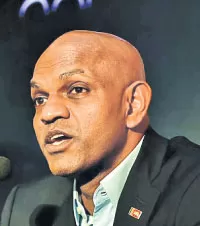
WSO2 CEO Sanjiva Weerawarana speaks to media during a product launch in Colombo on February 26, 2014.
The transaction, which remains subject to regulatory approvals, means that EQT will become WSO2’s sole owner, procuring all outstanding shares, including those of WSO2’s investors and current and ex-WSO2 employees.
This liquidity event could also create significant wealth among those inclined to start their own ventures, given that 30% of the proceeds will be going to those employees.
“This shows that equity is important — one of the things that we have insisted on from day one is that every employee has been a shareholder,” WSO2 Co-Founder and CEO Sanjiva Weerawarana told TechCrunch in an interview. “That’s very important and it’s a concept that has not been understood here before, because there haven’t been companies that exited and gave any amount of meaningful financial return. Seeing is believing, right? Talk is cheap.”
Thriving through war and unrest
Founded out of the Sri Lankan capital, Colombo, in 2005, WSO2 is a middleware stack constituting tools such as API management, similar to Apigee (Google acquired for $625 million) and identity and access management (IAM), along the lines of $15 billion publicly traded Okta.
The main driving force behind this has been Weerawarana, a computer scientist and key figure in the open source community over the past 25 years, both as a member of the Apache Software Foundation and more recently as the creator of Ballerina, a cloud-native general-purpose programming language for integrating distributed systems.
Prior to WSO2, Weerawarana worked within IBM’s research and development team in the U.S., where he helped develop web service specifications such as WSDL and BPEL and it was there that the seed for WSO2 was sown.
“I actually tried inside IBM to build a new kind of middleware stack, but IBM wasn’t interested,” Weerawarana said. “So the only option was either start a company or give up on the idea.”
Weerawarana spawned WSO2 in August 2005 alongside two co-founders: Davanum Srinivas, who left after two years and Weerawarana’s former IBM colleague Paul Fremantle, who would go on to serve as CTO until stepping down in 2015 (he later rejoined and then left again, but remains as an advisor.)
Notably, WSO2’s centre of gravity has remained in Sri Lanka, despite a long-standing civil war and external pressure to relocate to the U.S., where Weerawarana had lived previously for 16 years.
Today, 80% of WSO2’s 780 employees are in Sri Lanka, with the remainder spread across a smattering of hubs in the U.S., Europe and Asia.
“I wanted to show we could build a product-oriented tech company from Sri Lanka,” Weerawarana continued. “There had never been a company like this and at that time there wasn’t even a company out of India like this. Indian companies were very services-oriented, as were Sri Lankan companies. But one of the big prices (for staying in Sri Lanka) was that at pretty much every funding round, the majority of investors would ask when I was moving back (to the U.S.). And my answer was always the same: ‘I’m not moving back.’”
Investors weren’t the only ones who pressured WSO2 to move: Customers and competitors have also used its location against it at various junctures.
“Some of our competitors fought against us, saying, “Do you know where they are located? and that becomes a challenge,” Weerawarana said. “Then we’ve had customers saying, “You’re located way over there. Why are you charging us these prices?’”
On the flip side, WSO2’s geographic setting gave it the pick of technical talent, owning mostly to the fact that it was a product-based business in a sea of services.
Intel Inside
After WSO2 raised a small round of angel funding in 2005, Intel’s VC arm emerged as its earliest backer, investing in 2006 and through several follow-on rounds in subsequent years.
Intel Capital’s initial $2 million cash injection was critical to WSO2’s early growth and was the result of fortuitous timing. Pradeep Tagare was a senior investment manager at Intel Capital at that time and met Weerawarana through their associations with the Apache Software Foundation.
Tagare was looking to invest in an open source startup to complement a duo of other open source investments it had made — one into Java-centric application server company JBoss (which Red Hat later acquired for $350 million) and another into database company MySQL (which Sun later snapped up for $1 billion).
“We were looking at a bunch of open source investments as a strategic initiative for Intel, essentially to build an alternate stack on Intel hardware,” Tagare explained to TechCrunch. “We had invested in JBoss, and we invested in MySQL. So we were now looking for an open source middleware company and WSO2 fit the bill exactly.”
“Now they could contribute — before, it was all really controlled by the Microsofts and the Oracles of the world,” Tagare said. “Its location wasn’t necessarily a requirement, but being based in Asia just made WSO2 even more interesting.”
Much has changed in the 20 years since WSO2 arrived on the scene.
According to Crunchbase data, WSO2 raised $133 million over the years. However, Weerawarana clarified that only $70 million was primary capital. Other rounds, like the $93 million Series E round two years ago led by Goldman Sachs, consisted of equity and debt.
However the funding is sliced and diced, there’s no ignoring the fact that WSO2 was a startup dinosaur by the time EQT came calling. After all, most successful VC-backed companies reach an exit within 10 years.
So what gives?
“We’ve had multiple people wanting to buy our company through the years, but I resisted because I always wanted to build a company that would reach an IPO — an independent business, basically,” Weerawarana said.
That all changed in May, when WSO2 accepted an offer from EQT Private Capital Asia (formerly Baring Private Equity Asia), a private equity firm EQT acquired in 2022 for more than $7 billion. The difference this time was simple: One of WSO2’s controlling shareholders ‘wanted to get liquidity’, according to Weerawarana.
“Because they had more than 50%, it becomes a control transaction,” he said.
That shareholder was San Francisco-based Toba Capital, a VC firm set up by Vinny Smith in 2012 after he sold Quest Software to Dell for more than $2 billion.
Weerawarana says the company has been cash-flow positive since 2017 and profitable ‘since around 2018,’ but it hasn’t had the luxury of vast pools of capital that would allow it to look at ‘multiple year strategies.’ This is something it will be able to do under EQT, one of the world’s biggest private equity firms.
Indeed, WSO2 says it will hit $100 million in annual recurring revenue (ARR) by Q3 this year, which is one of the key reasons EQT came calling.
“WSO2 really has all the ingredients we look for in a software business,” EQT partner and global co-head of services Hari Gopalakrishnan told TechCrunch.
From the outside, selling to private equity might not seem like the dream outcome for a founder with ambitions to go public and who values his company’s independence. But Weerawarana insists that this outcome will better enable WSO2 to do just that.
“I started the company to make something that lasts. One of the reasons we didn’t sell it previously is that we knew that would be the end of it,” he said. “Their goal is to build the company for five years, which aligns with what I wanted, and gives us five years to get to an IPO.”
The pandemic, among other global events, put a temporary halt on Weerawarana’s Uber driving exploits; because people were doing it for survival, he didn’t want to take money from people who needed it.
“I will do it again — things are getting much better,” he said. “Tourism is almost back to normal, so the demand will be there and it might make sense for me to drive. But I don’t want to take any business from somebody else.”
The post Meet Founder who built and sold $600 mn enterprise software startup from Sri Lanka appeared first on DailyNews.