


Sri Lanka probes deaths after anti-nausea injection as grieving families seek answers
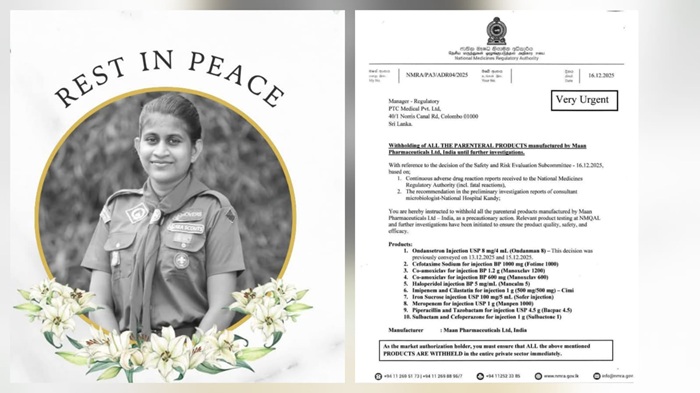
Sri Lankan health authorities have launched a high-level investigation into two deaths and several adverse reactions reported at government hospitals after patients were administered an anti-nausea injection, prompting regulators to suspend multiple drug batches linked to an Indian manufacturer.
The deaths, including that of a 23-year-old woman receiving treatment for dengue at the National Institute of Infectious Diseases (IDH), have raised fresh concerns over drug safety and oversight in the country’s public health system.
The young woman, identified as Sandumini Divyanjali, was admitted to IDH earlier this month with dengue fever. Her father, Thushara Kumbalathara, told the media that she developed severe complications shortly after being given medication through a saline drip.
He said her condition deteriorated rapidly within an hour of the injection, with sudden fever spikes, chills and convulsions. She was transferred to intensive care but died within 24 hours of admission. An inquest later returned an open verdict pending further investigations.
“We suspect something went wrong with the medicine given at the hospital. We still have no report explaining what happened,” her father said.
Health officials later confirmed that Sandumini was among the patients who had been administered Ondansetron, an anti-emetic commonly used to control vomiting.
A second death, involving a 37-year-old woman, was also reported after she developed complications following the same injection, according to Health Minister Nalinda Jayatissa. Several other patients were reported to have suffered serious allergic-type reactions at hospitals in Colombo and Kandy.
In response, the National Medicines Regulatory Authority (NMRA) on Dec. 12 issued an “urgent” notice suspending the use and sale of four batches of Ondansetron Injection USP 8 mg/4 mL, marketed as Ondanman 8 and manufactured by Maan Pharmaceutical Ltd of India.
The affected batch numbers are OD24021E, OD25009E, OD25024E and OD25023E.
Deputy Health Minister Dr. Hansaka Wijayamuni said reports of mild complications linked to the drug had been received since late November, but authorities escalated action after the deaths and severe reactions were flagged.
“Once a death is reported, we treat it with the utmost seriousness,” he said, adding that all injections supplied by the same manufacturer have been temporarily suspended pending a full investigation.
On Dec. 16, the NMRA expanded the suspension to include 10 medicines imported through the same company, halting their use in both government hospitals and private pharmacies.
NMRA Chairman Dr. Ananda Wijewickrama said initial alerts about possible contamination were received from hospital specialists, leading to an emergency review by a technical committee.
At the same time, health officials cautioned that investigations are ongoing and that it has not yet been conclusively established whether the deaths were directly caused by the drug, underlying illnesses or other treatments administered.
Health Minister Jayatissa acknowledged limitations in Sri Lanka’s capacity to test every imported drug shipment, noting that most quality checks are triggered after adverse events are reported.
Doctors’ groups have called for stronger regulatory safeguards, urging authorities to determine whether the problem occurred during manufacturing, transportation or storage.
“Identifying whether the defect occurred at the production stage is critical,” said Dr. Chamil Wijesinghe, a spokesman for the Government Medical Officers’ Association. “Public confidence depends on transparent answers.”
For families like Sandumini’s, those answers cannot come soon enough.
“She went to the hospital to recover,” her father said. “We just want to know why she never came home.” (Newswire)
The post Sri Lanka probes deaths after anti-nausea injection as grieving families seek answers appeared first on Newswire.