


Court Packing, Sri Lankan Style Constitutional Implications for the Independence of the Judiciary
By Ajith P. Perera, Attorney at Law Member of Parliament, Member, Constitutional Council
The 22nd Amendment would raise the Court of Appeal ceiling from 20 to 25 judges, including its President. The Judicature Amendment Bill would raise the High Court ceiling from 110 to 120. Adding previously recorded vacancies gives the following calculation.
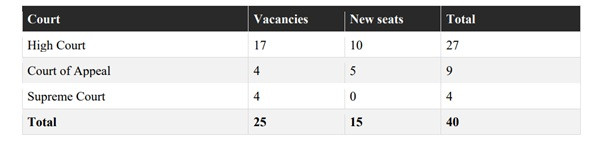
The constitutional danger is not the appointment of 40 judges as such. The danger arises when a large number of judicial positions are created or filled within an exceptionally short period and the appointments are concentrated in the hands of the President. Such a process can alter the composition of the judiciary for many years and may create the functional equivalent of court packing, even if each individual appointment is formally lawful.
The Government should not proceed with judicial expansion until it explains how the additional judges will be selected, why these numbers are necessary and what prevents political preference from shaping the bench. The central question is whether the manner, timing, scale and selection mechanism of approximately 40 appointments could allow the political executive to reshape the judiciary within a short period. That danger a politically controlled restructuring of the courts is the risk Parliament must confront.
BASL concerns over High Court and Court of Appeal Appointments
The Bar Association of Sri Lanka’s concern goes directly to the appointment process. In a letter to the President reported on 31 December 2025, BASL questioned departures from seniority in promotions involving judicial officers and judges of the High Court and Court of Appeal.
BASL called for transparent, fair appointments and promotions. It urged that seniority remain the basis for promotion until objective, defensible merit guidelines existed, subject to recognised demerit or other objectively identifiable compelling circumstances.
That warning exposes a fundamental accountability problem. If merit justifies passing over a candidate, the standards for judging merit must be known. Otherwise, the public cannot distinguish professional assessment from preference. The answer must be a published procedure that can be applied consistently, not an assurance that the right people will be chosen.
The IMF identified the same institutional weakness
The IMF’s 2023 Governance Diagnostic Assessment separately identified an absence of clear, transparent procedures for senior judicial selection. Paragraph 285 of the assessment also reported no documented criteria supporting judicial promotion, transfer and career progression, while noting extensive responsibilities concentrated within a small JSC structure. This finding predates the present administration. It identifies an inherited vulnerability that the Government has a responsibility to address before expanding 2 appointments. The IMF recommended clearer criteria for recruitment, promotion and dismissal, alongside protection for institutional independence. The 2025 IMF review also noted plans to collate and review existing judicial conduct guidance furthermore.
The Speaker shut the door on scrutiny
The transparency controversy had already reached Parliament. On 21st November 2025, Opposition Leader Sajith Premadasa, myself, and several other Members of Parliament submitted a motion for a select committee to examine the JSC’s exercise of appointment, promotion, transfer, dismissal and disciplinary powers.The proposed inquiry asked whether decisions followed the Constitution and relevant rules, whether reasons were recorded and communicated, and whether extraneous considerations had influenced decisions.
On 9 January 2026, Speaker Jagath Wickramaratne ruled the motion out of order. He said parliamentary oversight of JSC operations would violate the constitutional separation of powers and judicial independence. The motion therefore preceded the BASL letter reported in December; its rejection followed that warning.
In my view, however, the Speaker’s decision to rule the motion out of order was wrong. Judicial independence should not place the Judicial Service Commission beyond legitimate parliamentary scrutiny. Article 4(c) of the Constitution itself provides that the judicial power of the People shall be exercised by Parliament through courts, tribunals and institutions created or recognised by the Constitution or by law. Scrutiny is not interference. If Parliament, which derives its authority from the sovereignty of the People, cannot question the transparency and accountability of the JSC, then who can? Judicial independence must protect the judiciary from improper influence, not shield the institutions governing it from legitimate questions of accountability.
The court packing risk posed by the proposed 22nd Amendment must be understood against this background: an expansion of judicial appointments while questions about the transparency of selection remain unresolved and parliamentary scrutiny has been rejected.
Vacancies Cannot Become a Political Opportunity
My considered view is that vacancies were allowed to accumulate so appointments could later be made in bulk. The figures alone cannot prove that motive. However, the President’s reference to the Easter Sunday High Court Trial and promotion consequences does not, in my view, justify the delays. The four reported Supreme Court vacancies separately require a clear explanation: when did they arise, what prevented appointments and why did the delays continue?
The consequences are already visible. Justice Dhammika Ganepola retired on 8 May 2026 without elevation to the Supreme Court despite four vacancies, a concern expressly raised by BASL. Justice Rathanapriya Gurusinghe also retired without elevation despite a recommendation from former Chief Justice Murdu Fernando, according to BASL’s President. Experienced judges thus retired while opportunities for appointment remained.
In my view, this sequence deepens the suspicion of an ulterior motive and demands a direct answer from the President. A concentrated wave of appointments can shape the courts for years, even where each appointment satisfies formal requirements. Delays in filling judicial vacancies must not become a political opportunity to reshape the judiciary through appointments made in bulk.
Judicial independence belongs to the institution
Judicial independence is not merely the independence of individual judges; it is also the institutional independence of the judiciary from the political branches of government.
A government need not instruct a judge how to decide a case to threaten that independence. Political influence over the selection process can affect the institutional balance before a case is heard. That is why safeguards must operate before appointments, rather than depend on proving interference afterwards.
Court packing has a global playbook
Venezuela shows how expansion can become capture
Venezuela supplies a particularly relevant warning. In 2004, legislation expanded its Supreme Court from 20 to 32 members. Human Rights Watch reported that the governing coalition filled the 12 new seats and 5 existing vacancies, describing the process as court packing.
The lesson for Sri Lanka concerns that combination. New seats, accumulated vacancies and politically influenced selection can enable a rapid restructuring. The comparison is about the danger of that mechanism; it does not establish that Sri Lanka has already reproduced Venezuela’s outcome.
Argentina and Roosevelt reveal the same temptation
In Argentina, President Carlos Menem expanded the Supreme Court from 5 to 9 members in 1990. Human Rights Watch records that allies filled the new openings, producing what became known as an “automatic majority”. Court size became an instrument of political advantage.
Roosevelt’s 1937 proposal could have expanded the US Supreme Court from 9 justices to 15 after the Court struck down major New Deal measures. The expansion failed in Congress. It remains a warning that administrative explanations can accompany attempts to change judicial composition.
Poland: Changing Who Chooses the Judges
Poland’s 2017 reforms shifted the selection of 15 judicial members of the National Council of the Judiciary to Parliament, created new Supreme Court chambers and lowered the retirement age. The Venice Commission warned that approximately 40% of Supreme Court judges could leave, with replacements appointed through a newly constituted council dominated by political appointees.
Hungary: Clearing Seats, Controlling Succession
Hungary’s 2012 changes abruptly reduced judges’ mandatory retirement age from 70 to 62. The Venice Commission estimated that between 225 and 270 judges, including many senior officeholders, would retire within a short period. It found no convincing justification for forcing out a generation of serving judges.
A six month moratorium on judicial appointments compounded the concern. The Commission considered that this appeared intended to channel new appointments including court leadership positions through the new system, giving the newly elected President of the National Judicial Office a central role. Hungary therefore illustrates why the timing of vacancies and the arrangements for filling them deserve scrutiny alongside changes to court numbers.
Explain the Expansion Before Approving It
The Government must explain why five additional Court of Appeal judges and ten additional High Court judges are necessary, and how those numbers were determined. Parliament and the public are entitled to see the workload figures, vacancy records and reasons supporting the proposed increases.
BASL’s concerns and the IMF’s findings make transparency in appointments particularly urgent. The Government should explain how it proposes to address those concerns, while respecting the distinct constitutional responsibilities of the President, the Judicial Service Commission and the Constitutional Council.
Parliament should not approve an expansion of judicial appointments while fundamental questions about their necessity and the transparency of selection remain unanswered.
The Government’s Term Will End. Its Appointments Will Remain.
BASL has called for transparency. The IMF has identified weaknesses in judicial selection. The proposed parliamentary inquiry has been rejected. Against that background, expanding the opportunities for appointment before addressing the safeguards is a constitutional risk the country should not accept.
The Government must publish the justification for expansion, account for the accumulated vacancies and establish clear selection criteria. Parliament should insist on those answers before approving additional seats. The public is entitled to know how those entrusted with administering justice are chosen.
A concentrated wave of appointments can shape the judiciary long after this Government leaves office. By the time the consequences become clear, the opportunity to prevent them may have passed.
No government should be allowed to turn a temporary parliamentary majority into enduring influence over the courts. The judiciary must remain strong enough to hold accountable the very people who appoint its judges.
The post Court Packing, Sri Lankan Style Constitutional Implications for the Independence of the Judiciary appeared first on Newswire.