


US trains Sri Lankan officials to detect maritime sanctions evasion
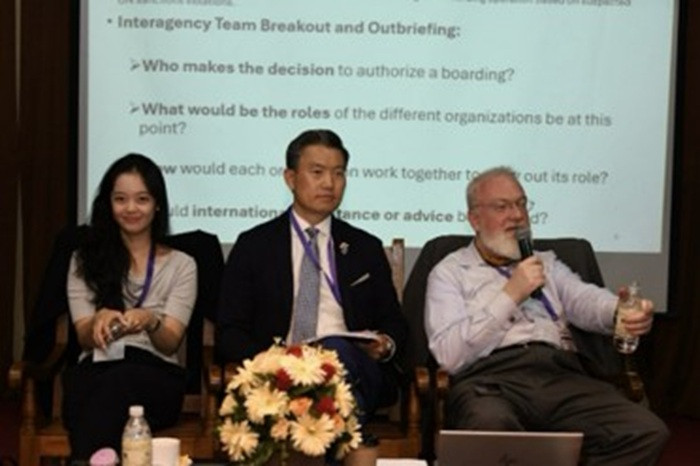
The United States has trained more than 40 Sri Lankan officials to identify suspicious vessels, detect deceptive shipping practices and respond to potential sanctions evasion in and around Sri Lankan waters, as maritime networks increasingly use complex methods to conceal illicit activities.
The three-day training programme, held in Colombo from September 9 to 11, was conducted by the US Embassy in Sri Lanka through the US Department of State’s Office of Cooperative Threat Reduction, in partnership with the Atlantic Council.
According to the US Embassy, the programme was aimed at strengthening Sri Lanka’s capacity to detect and respond to maritime sanctions evasion that could threaten US security interests and legitimate global commerce.
More than 40 officials representing several key Sri Lankan institutions participated in the programme, including the Sri Lanka Atomic Energy Regulatory Council, Central Bank of Sri Lanka, Sri Lanka Coast Guard, Merchant Shipping Secretariat, Sri Lanka Ports Authority, Ministry of Defence and Sri Lanka Navy.
The officials received training in the use of tools to identify suspicious vessels and deceptive shipping practices, assess sanctions and proliferation risks, and improve coordination between government agencies when potentially illicit maritime activity is detected.
Participants examined several techniques used to conceal maritime activity, including the manipulation of vessel identification and tracking information, opaque ownership structures, ship-to-ship transfers and falsified documentation.
The programme also focused on other practices used to obscure the identity and ownership of vessels, as well as their cargo, origin and destination.
Presentations and tabletop exercises were conducted by sanctions and maritime security experts from the Atlantic Council, allowing Sri Lankan officials to gain practical experience in identifying warning signs and carrying out due diligence on vessels and entities associated with them.
The workshop also covered US sanctions and applicable United Nations Security Council sanctions, while participants were trained to assess financial and proliferation risks and coordinate responses across Sri Lankan government institutions.
Meanwhile, the US Embassy highlighted potential sanctions-related risks faced by shipping agents, bunkering or fuel providers, and other companies providing services to sanctioned vessels, whether knowingly or unknowingly.
The Embassy said the United States has previously designated entities, including brokers, fuel suppliers and cargo certifiers, for facilitating the operations of sanctioned vessels.
It warned that providing services such as fuel, food or other provisions to a sanctioned vessel could expose companies and individuals to US sanctions risks, including possible civil or criminal penalties.
US Ambassador to Sri Lanka Eric Meyer said Sri Lanka’s position along major global trade routes creates significant economic opportunities while also requiring vigilance against the misuse of commercial shipping.
“Sri Lanka sits at a strategic crossroads for global commerce, bringing both tremendous opportunity and the need for vigilance,” Meyer said.
He said sanctions-evasion networks are increasingly exploiting commercial shipping and that the United States is sharing its expertise with Sri Lankan authorities to protect legitimate trade, secure critical waters and strengthen regional security.
The US Embassy noted that sanctions-evasion networks increasingly rely on complicated international shipping and financial structures to conceal illicit activities while taking advantage of legitimate commercial networks.
Given Sri Lanka’s position as a major Indian Ocean transshipment hub, the Embassy said the country’s ability to protect its ports and surrounding waters against illicit maritime activity is important for safeguarding legitimate trade.
It added that continued cooperation between the United States and Sri Lanka in this area is aimed at strengthening maritime security in Sri Lanka and across the wider region. (Newswire)
The post US trains Sri Lankan officials to detect maritime sanctions evasion appeared first on Newswire.