


US report flags major hurdles for foreign investors in Sri Lanka
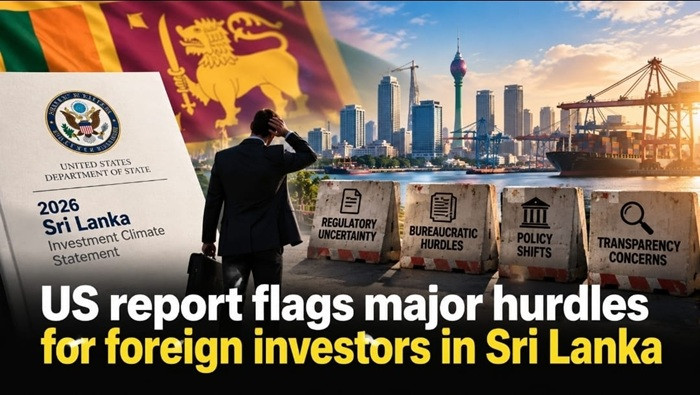
Sri Lanka’s investment climate continues to face significant challenges despite stronger economic growth and the country’s ongoing recovery from the 2022 economic crisis, with foreign investors continuing to raise concerns over regulatory unpredictability, bureaucratic hurdles, policy shifts and transparency, according to a new assessment of the country’s investment environment.
The 2026 Sri Lanka Investment Climate statement by the United States Department of State notes that Sri Lanka, a lower-middle-income country with a population of around 22 million, recorded 5 percent GDP growth in 2025, exceeding expectations and strengthening its economic recovery.
It says the electoral victories of President Anura Kumara Dissanayake and the National People’s Power (NPP) in late 2024 have provided political stability, while the government’s commitment to Sri Lanka’s US$3 billion, four-year Extended Fund Facility programme with the International Monetary Fund (IMF) has also provided reassurance to investors.
However, the assessment says investors remain cautious over what it describes as mixed messaging regarding the openness of the Sri Lankan market.
FDI reaches US$1.06 billion
Foreign Direct Investment (FDI) into Sri Lanka reached US$1.06 billion in 2025, equivalent to approximately 1 percent of GDP, which the report says remains significantly below the 3 to 4 percent commonly recorded in emerging economies.
Manufacturing, port development, tourism, information technology and business process outsourcing, and real estate were identified as the sectors attracting the most foreign investment during the year.
Investment experts cited in the assessment identify policy stability, regulatory reform, availability of skilled labour, access to industrial land, efficient logistics and streamlined trade procedures as key areas requiring improvement if Sri Lanka is to meet its FDI targets.
The report also notes that access to preferential export markets through Free Trade Agreements is an important consideration for investors because such agreements can improve export competitiveness and reduce the cost of imported raw materials and intermediate goods.
Regulatory uncertainty and bureaucracy remain concerns
Despite government efforts to promote foreign investment, the report says regulatory unpredictability, bureaucratic hurdles and selective transparency continue to restrict broader participation by foreign companies.
Investors have cited project reversals, regulatory shifts, slow decision-making and inadequate support for established businesses among their concerns.
The IMF and local business chambers have meanwhile stressed the importance of broader structural reforms, including trade facilitation, digitisation and stronger governance mechanisms.
The Board of Investment (BOI), Sri Lanka’s principal investment promotion agency, also faces difficulties operating as an effective “one-stop shop” due to authority being fragmented across multiple government departments, resulting in lengthy approval processes, according to the report.
It notes, however, that the BOI launched its Ready to Invest digital platform in May 2026, featuring sector-specific investment opportunities.
Foreign investors have also reported high transaction costs, unpredictable policies and opaque procurement procedures, while inefficient state-owned energy enterprises are identified as another obstacle to securing cost-effective energy supplies for industrial operations.
Major investment projects highlighted
The report notes that Sri Lanka allows 100 percent foreign ownership in most economic sectors, while providing constitutional guarantees for investment protection and unrestricted repatriation of earnings, fees and capital.
It highlights several major investment developments under the current administration.
In January 2025, President Dissanayake committed to finalising a proposed US$3.7 billion Sinopec oil refinery project near the Hambantota International Port, described in the report as potentially the largest FDI project in Sri Lankan history. However, as of June 2026, the project remained pending amid disagreements between the government and Sinopec.
The report also refers to Indian company Adani Green Energy’s withdrawal in February 2025 from a proposed US$400 million, 484 MW wind power project in northern Sri Lanka, citing government efforts to renegotiate the previously awarded contract.
It further says the government ended negotiations with China Harbour Engineering Company over a proposed floating LNG terminal in December 2025 and halted plans to privatise several state-owned enterprises, opting instead for turnaround and restructuring measures under continued state ownership.
Foreign ownership restrictions remain in several sectors
While foreign investment is permitted across much of the economy, restrictions continue in several areas.
Foreign investment in sectors including air transportation, banking, coastal shipping, alcohol production, large-scale mechanised gem mining, lotteries, military hardware manufacturing and security document printing requires relevant government approval and may be subject to ownership or licensing restrictions.
Foreign investment is entirely prohibited in coastal fishing, money lending, pawnbroking and retail businesses with capital investments below US$5 million.
Foreign ownership exceeding 40 percent has also historically required approval in certain activities, including tea, rubber, coconut, cocoa, rice, sugar and spice cultivation, education, freight forwarding, mass communications, mining, natural-resource extraction, shipping agencies, travel agencies and several other sectors.
Land ownership remains another challenge, with Sri Lankan law generally prohibiting land sales to foreigners and companies with foreign equity exceeding 50 percent, subject to limited exemptions.
Trade agreements and RCEP
Sri Lanka currently has bilateral free trade agreements with India, Pakistan, Singapore and Thailand, while also participating in regional and multilateral trade arrangements including SAFTA, GSTP, SAARC and APTA.
The country also benefits from the European Union’s GSP+ preferential trading arrangement.
The report states that Sri Lanka has expressed its intention to join the Regional Comprehensive Economic Partnership (RCEP) and is progressing through the formal accession process.
Trade facilitation and legal challenges
Regulatory unpredictability, outdated regulations and broad administrative discretion are frequently cited by businesses as obstacles, while investment inflows are also affected by restrictive labour regulations, complex tax structures, cumbersome contract enforcement and difficulties in acquiring land.
The report says there is no legally mandated consultation process for new laws in Sri Lanka, meaning stakeholder engagement can vary between ministries.
Trade facilitation also requires substantial improvement, with strict import licensing, high duties and para-tariffs, complex labour regulations and intellectual property concerns identified as impediments.
Despite calls from businesses for greater digitisation, manual procedures remain at important institutions including Sri Lanka Customs, the Sri Lanka Ports Authority and the BOI, according to the assessment.
Weak contract enforcement is also identified as a significant obstacle to business growth, with substantial court backlogs continuing to affect dispute resolution.
Colombo Port City and investment zones
Sri Lanka currently operates 18 Export Processing Zones administered by the BOI, where foreign investors receive the same treatment as local entities.
The report also highlights the Colombo Port City Special Economic Zone, established on 665 acres of reclaimed land near Colombo Port. It says the current administration intends to review the Port City legislative framework to improve its attractiveness to investors.
An amendment introduced in January 2026 limits tax holidays, harmonises employee taxation and establishes stricter regulatory oversight and compliance requirements.
Separately, a 400-acre pharmaceutical manufacturing zone in Hambantota aims to develop domestic production capacity sufficient to meet 40 percent of Sri Lanka’s pharmaceutical requirements and generate up to US$1 billion in annual exports.
Banking sector strengthens
Sri Lanka’s banking system comprises 30 licensed institutions, including 24 licensed commercial banks and six licensed specialised banks.
Banking-sector profits after tax increased 19 percent year-on-year to approximately US$1.2 billion in 2025, while total banking assets grew 12 percent to around US$80 billion by the end of the year.
All banks maintained capital above minimum regulatory requirements, while the total Capital Adequacy Ratio stood at 18 percent at the end of 2025.
The Central Bank purchased US$2 billion in foreign exchange during 2025, while gross official reserves increased to US$6.8 billion, their highest level since the 2022 economic crisis.
Workers’ remittances also reached a record US$8.1 billion in 2025, compared with an estimated US$6.6 billion in 2024.
Concerns over SOEs and corruption
The report says the Sri Lankan government controls 527 state-owned enterprises, including 55 considered strategically important.
It identifies mismanagement, excessive staffing, inadequate financial disclosure and weak budgetary controls as persistent problems within the SOE sector.
While the previous administration pursued a programme that included potential privatisation of major SOEs, the current government suspended those efforts and has instead proposed restructuring focused on improving management, reducing costs and increasing efficiency while retaining state ownership.
Corruption and lack of transparency in public procurement are also identified as longstanding obstacles to attracting FDI.
The report notes President Dissanayake’s public commitment to tackling corruption and improving government transparency, but says stakeholders continue to identify corruption risks in some sectors and raise concerns about politically connected interests.
Sri Lanka strengthened its anti-corruption framework through legislation passed in July 2023, although the assessment says weaknesses remain in conflict-of-interest provisions and enforcement.
Skilled labour shortage a growing challenge
Skilled labour shortages are described as a critical operational challenge, with significant emigration from sectors including tourism, apparel, information technology and engineering creating talent gaps.
Sri Lanka’s employed workforce stood at 8.1 million in 2025, with 50.6 percent employed in services, 26.3 percent in industry and 23.2 percent in agriculture. Government agencies employ more than 1.3 million workers, according to the report.
The report says labour costs remain comparatively low against developed economies but are generally higher than competing South Asian countries, while businesses continue to report shortages of specific technical skills.
Younger workers are also showing declining interest in labour-intensive employment, contributing to shortages in construction, plantation agriculture and manufacturing. The garment industry reportedly experiences annual employee turnover of up to 40 percent.
More than 310,000 Sri Lankans registered for overseas employment in 2025, while skilled-worker emigration has continued, further adding to domestic labour shortages.
Overall, the assessment portrays an investment environment that has benefited from Sri Lanka’s economic recovery, stronger growth and greater political stability, but says attracting substantially higher levels of foreign investment will depend on progress in policy stability, regulatory reform, trade facilitation, governance, skilled labour availability and reducing bureaucratic obstacles.
Report : https://www.state.gov/wp-content/uploads/2026/09/701264_2026-Sri-Lanka-Investment-Climate-Statement.pdf (Newswire)
The post US report flags major hurdles for foreign investors in Sri Lanka appeared first on Newswire.