


Total tea export revenue to reach USD 1.2 Bn in 2022

Sri Lanka’s total tea export revenue will reach USD 1.2 billion for 2022 and the export volume for 2022 is expected to be 250mn/kg, Chairman of the Sri Lanka Tea Board Niraj De Mel said.
Iraq was the leading export destination for Ceylon tea having imported 41 million Kgs and accounting for 18% of the total export volume. Other key export destinations for Ceylon tea were Russia (22.96 million Kgs), UAE (20.31 million Kgs), Turkey (13.52 million Kgs), Iran(11.96 million Kgs), Azerbaijan (11.27 million Kgs), Libya (10.79 million kgs), China(10.48 million Kgs), Chile(6.22 million Kgs) and Germany (6.17 million Kgs).
Owing to the marked decline of supply caused by production shortfall, coupled with the sharp depreciation of the Sri Lankan rupee against the US dollar, tea Auction prices registered a steep increase, moving up to an average of USD 3.80 per Kg by end November 2022 from USD 3.10 per kg at the beginning of the year.
During the year 2022 (up to November), a total of 231 million Kgs was exported. This was 12% lower than the 262 million Kgs exported during the same period of last year.
The export earnings in real value decreased by USD 168 million from USD 1.21 billion (USD 1,214 Million) recorded in 2021 to USD 1.05 billion (USD 1,046 million) up to November in 2022. Lower earnings were attributed to low production in the year under review.
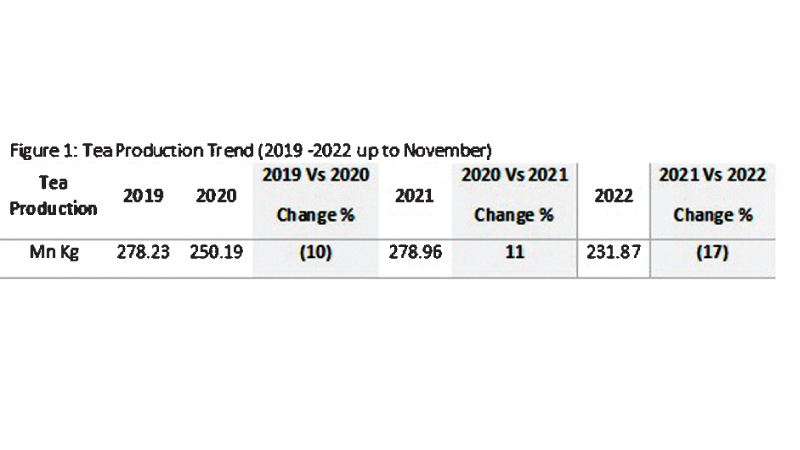
Made tea production for the year up to end November was 231.87 million Kgs. This is significantly lower compared to 278.96 million Kgs recorded for the same period in 2021. It is also lower than 250.19 million Kgs produced during the corresponding period in 2020.
Out of the total production for 2022, the Smallholder sector output was 174.71million kgs (75%) while the RPC sector accounted for 75.8 million kgs (33 %). Both sectors recorded decreased outputs with the greatest decline of 20% being registered from the RPC sector. The production shortfall in the small holding sector was 16%.
Subsequent to the banning of Chemical fertilizer by the Government of Sri Lanka in 2021, tea growers and large plantations, in particular, were forced to only use organic fertilizer which too was not adequately available resulting in a negative impact on the Tea production. A drop of 17% compared to the previous year has been recorded up to the end November 2022.
With the Government’s decision to allow a more generous policy on fertilizer, all expectations are that the country’s tea production in 2023 would improve to at least 290 million kilos.
It is believed that the initiative re-launched jointly by the Sri Lanka Tea Board and Tea Small Holdings Development Authority’s titled B 60 or “Sahakampanaya” in September this year would contribute favourably towards achieving a higher crop.
The objective of this program is to increase the intake of better green leaf which will also help growers and plantations to return to 4 plucking rounds per month from the present 2 rounds.
The drawback however is the shortage of tea pickers which will have to be addressed soon. Expectation of an increase in production next year is however subject to the weather conditions remaining conducive for growth throughout the year 2023.Ageing tea bushes and low productivity levels could also act as a downside.