

Auditors have reporting obligations to the CSE
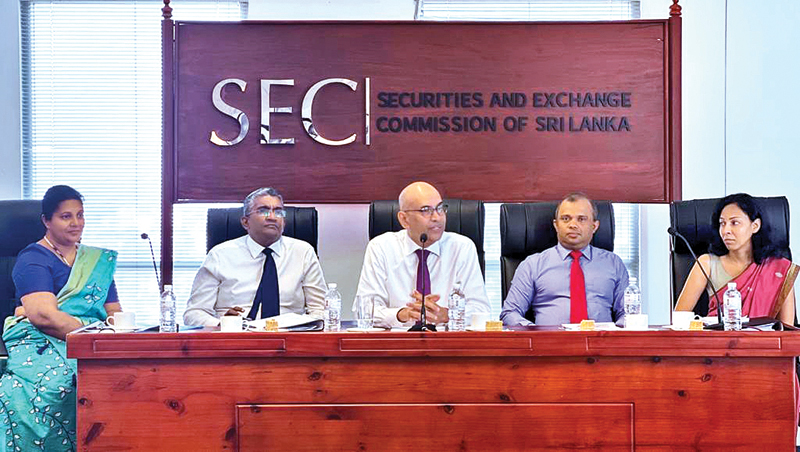

SLASSMB Director General Anusha Mohotti, SEC Director General Chinthaka Mendis, SEC Chairman Faizal Salieh, SEC Commission Member and President of the Institute of Chartered Accountants of Sri Lanka Sanjaya Bandara, and SEC Acting Director Corporate Affairs Manuri Weerasinghe.
Auditors have a reporting obligation to the CSE Board in instances where the auditor flags a breach or non-compliance of the Rules of the Market Institution where applicable said Chairman of the Securities and Exchange Commission of Sri Lanka (SEC), Faizal Salieh when he and top officials of the SEC met with the Principal Partners of Audit firms recently at the SEC.
The SEC Chairman said that the Auditor should promptly inform the CSE if the auditor is aware of a situation that adversely affects the financial position of a Market Intermediary to a material extent.
Highlighting the duties of Auditors of Public Listed Companies, the SEC Chairman said that if an auditor becomes aware of a contravention or non-compliance with any law, rule, regulation or regulatory directive issued under the Act; an offence involving fraud or dishonesty; a matter which adversely affects or may affect the financial position of a listed company; an irregularity that has or may have a material effect on the accounts of the company; or an irregularity that jeopardizes or may jeopardize the funds or property of investors, then the auditor has a duty by law to promptly report it in writing to the Board Audit Committee of the listed company.
He further elaborated that in the event the Board Audit Committee fails to rectify the matter or take action within two weeks, the auditor is required under the Act to inform the Board of Directors. He also added that in the event no action is taken by the Director Board within two weeks, the auditor should promptly red-flag it to the SEC.
“To establish a fair, orderly and transparent capital market it is important that the whole gamut of a company’s governance and risk management structures and processes are rigorously audited.”
“Therefore, the scope of the audit should be enhanced to assess the robustness of a company’s governance framework, policies, procedures and processes in place to mitigate risk and non-compliance including insider dealing, market manipulation, price rigging, etc. by Directors, C-Suite, KMPs and staff.”
Auditors have a responsible role to play in providing assurances that the internal control environments of entities operating in the capital market meet the required standards of good governance. Companies must move from a compliance box-ticking mode to an active practising mode.
“We as a regulator expect auditors to ask searching questions on these matters in the audit assurance process,” he emphasized. He explained that a director of a stock broking company cannot say that he or she was unaware of market misconduct by its Investment Advisor or employee because the Board of Directors is responsible for institutionalizing a robust and efficient governance framework within the entity. “Auditors, as the third line of defence, should look into the effectiveness of such frameworks, policies and procedures as part of the audit process. Nor should a director of any company claim unawareness of capital market regulations when engaging in share trading activities.”
Commenting on the role of the Sri Lanka Accounting and Auditing Standards Monitoring Board(SLAASMB), the SEC Chairman stated that the SEC does not intend to duplicate the work of SLASSMB but to work in tandem with them in analyzing the financials of entities.
He highlighted the need to red flag market-sensitive issues and errors in the financial reports and promptly require companies to rectify the errors and re-publish the financial statements.
“Corporate failure is not an event but a process. The audit process should verify whether companies have the systems and processes in place to pick up the signs and flag them promptly. Auditors must proactively blow the whistle if they don’t,” he noted.