


Sajith, IMF discuss Sri Lanka’s post-EFF economic outlook and reform programme
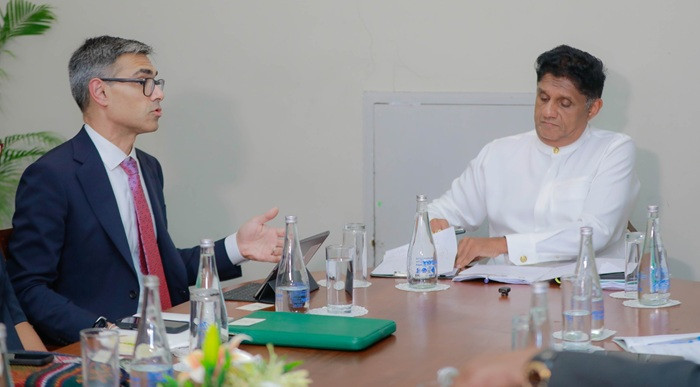
Sri Lanka’s economic outlook beyond the current IMF-supported Extended Fund Facility (EFF) programme, the implementation of ongoing reforms and the country’s ability to maintain economic stability after March 2027 were the focus of discussions between Opposition Leader Sajith Premadasa and an International Monetary Fund (IMF) delegation at Parliament.
The meeting, held at the Opposition Leader’s Office, centred on Sri Lanka’s current economic situation, progress under IMF-backed programmes and the path the country should take after the conclusion of the present EFF arrangement.
During the discussions, both sides reviewed Sri Lanka’s external sector position, foreign exchange reserves, debt sustainability, fiscal conditions and economic growth prospects. They also examined the conditions required to preserve economic stability beyond the expiry of the current IMF programme and strengthen the country’s economic resilience after March 2027.
Particular attention was paid to measurable economic targets that Sri Lanka should achieve by the end of the current programme, including sustainable debt policies, sound public finances, manageable external financing requirements and stronger prospects for long-term economic growth.
Premadasa stressed that fiscal consolidation and economic adjustment measures should not place a disproportionate burden on working people and vulnerable households. While recognising the importance of maintaining macroeconomic stability and fiscal discipline, he urged greater attention to the economic difficulties faced by families and micro, small and medium-sized enterprises (MSMEs).
The Opposition Leader emphasised that the success of the IMF-supported reform programme should not be assessed solely through macroeconomic indicators but also through its impact on households, individuals and businesses. He called for a more people-centred approach that focuses on poverty, affordability, inflation and the financial pressures experienced by lower and middle-income families.
Premadasa further underscored the need for Sri Lanka to move beyond economic stabilisation towards sustainable and inclusive growth that generates investment, creates employment opportunities, increases household incomes and provides stronger economic security for the public. He also highlighted the importance of developing a credible economic framework beyond March 2027 that would maintain stability while enhancing the country’s capacity to withstand future external shocks.
Among the key issues discussed were the need to assess economic reforms beyond headline macroeconomic indicators and evaluate their impact on poverty, affordability, employment and household incomes. The parties also discussed the financial pressures faced by MSMEs, including debt-related challenges and their implications for entrepreneurship and productive capacity.
The importance of ensuring that fiscal consolidation and taxation measures do not disproportionately affect working people and vulnerable households was also highlighted, along with the need for reliable and timely household-level and poverty-related data to support evidence-based policymaking and assess the social impact of economic adjustment measures.
Premadasa reiterated that macroeconomic stabilisation should ultimately translate into measurable improvements in living standards, poverty reduction, affordability, household incomes and the economic security of working people.
He also sought clarification on the economic conditions and quantitative indicators that would determine whether Sri Lanka could successfully transition beyond the current EFF arrangement without a successor financing programme, as well as the circumstances under which continued IMF financial assistance would be considered.
The discussions took place as the IMF continues its engagement with Sri Lanka under the Extended Fund Facility programme. According to the current programme schedule, the seventh review is planned for October 2026, while the eighth review is scheduled for March 2027 based on performance through the end of December 2026.
The IMF delegation was led by Mission Chief Evan Papageorgiou and included Enrique Flores Curiel, Dinar Prihardini, Ursula Wiriadinata, Ozlem Aydin, Yorbol Yakhshilikov, Klakow Akepanidtaworn, Yan Chen, IMF Resident Representative Martha Woldemichael and Manavee Abeyawickrama.
Representing the Samagi Jana Balawegaya were MPs Harsha de Silva, Harshana Rajakaruna, Kabir Hashim, Hector Appuhamy, Ajith P. Perera and Mujibur Rahuman, as well as Professor Prasanna Perera, Talal Rafi, Kusum Wijetilake, Dilum Alagiyawanna and Suranga Ranasinghe. (Newswire)
The post Sajith, IMF discuss Sri Lanka’s post-EFF economic outlook and reform programme appeared first on Newswire.